Vertical Venting For A Pellet Stove
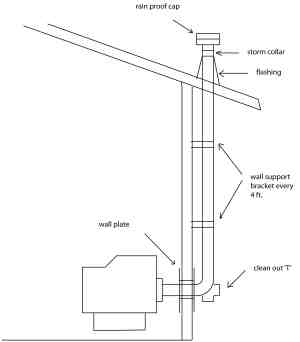
Vertical Venting Outside
The simplest and cheapest way to install vertical venting for your pellet stove is to run the flue outside, up an external wall of your house. Doing it this way means you don't have to disrupt the house inside or cut through ceilings with the resulting mess that can make.
The stove vent pipe will have to be supported every four feet using a bracket to attach it to the outside wall. If the eaves overhang considerably you will have to run the pipe through the roof at that point, but if the overhang is slight, two 45 degree bends will take the vent pipe clear. Remember to stay at least three inches away from plastic guttering.
If you are venting from the back of the stove, a clean out 'T' must be installed either inside the house if you are running the vent through the ceiling, or outside if you are running the vent externally.
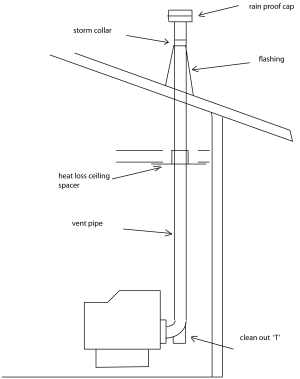
Vertical Venting Inside
If you decide to run your stove vent inside the building, the first thing to do is locate any possible obstructions to the run of the pipe. Locate the joists and rafters in the ceiling and roof around the pipe run you're considering because you really don't want to cut them.
The flue pipe must be kept at least three inches away from combustibles, which applies to joists and rafters. When going through the ceiling, a heat-loss/firestop spacer with a clamp to support the pipe will be needed.
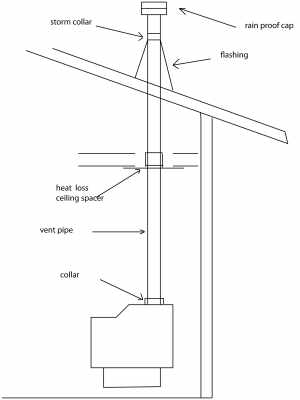
Roof / Cathedral Support Box
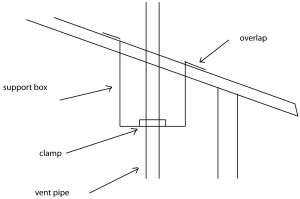
In the case of a house that 's open to the roof, or has no ceilings to support the stove pipe, a roof or cathedral support box must be used. This is really just a box which can be cut to the angle of the roof and fitted to it securely. At the base of the box is a clamp to hold and support the pipe.
Pages Related to Pellet Stove Vertical Venting
Chimney Vent Installation Three Or Four Inch Pellet Stove Venting? Pellet Stove Pipe. Selkirk Pellet Stove Pipe Hearth Pad Pellet Stove Horizontal Venting


Popular Pages
Small Stoves Installing Simple Venting Comparison Battery Backup Accessories Hearths and Hearth Pads Problems Cleaning Ash Vacuums Thelin Gnome Non Electric Pellet Stoves Jamestown J1000 Wood Pellet Machines
